
Aggressive dog behaviour is usually a response to something that the dog considers as a threat

All animals (including humans) show aggression at some point. Aggressive dog behaviour is usually a response to a threat, e.g. when defending their young ones, protecting themselves, or guarding their territories.
Recently we came across this interesting quote, which made us think about dog aggression in a new light
There are different types of dog aggression. Aggressive dog behaviour can be directed towards other dogs, people, objects, movement, etc.
Any dog can become aggressive at any time in his life. Some dog breeds are intentionally bred to be defensive but that does not make them aggressive dog breeds on its own. In every dog breed, there are dogs that use aggression inappropriately and others that don’t.
Dogs that have not had the right kind of experience in their life may learn that aggression can effectively solve some of their problems. Aggression is then likely to become the dog’s first choice to solve any problem. Even dog of the least defensive dog breed can become aggressive if he is raised the wrong way.
Aggressive dog behaviour is usually classified based on the purpose of the aggression. ASPCA (The American Society for the Prevention of Cruelty to Animals) classifies aggressive dog behavior as follows:
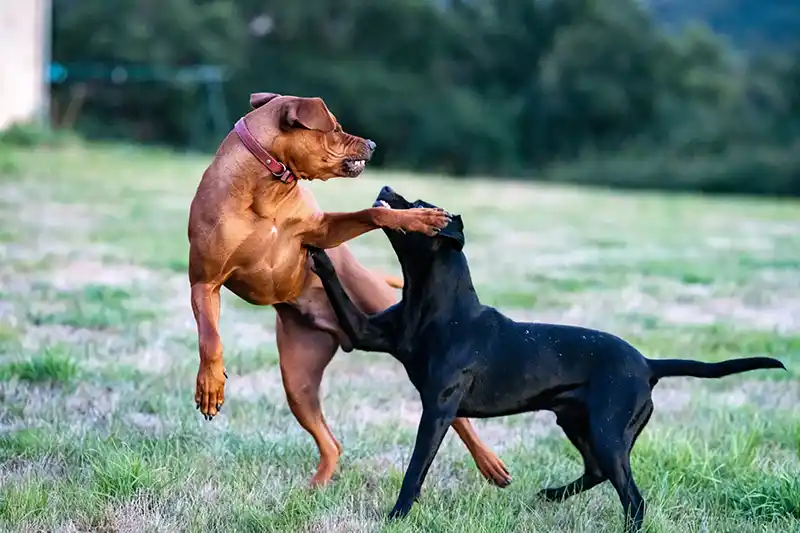
Dog behaviour modification techniques benefit aggressive dogs but is the dog cured of his aggression?
Most dog behaviour specialists believe that dog that have used aggression to deal with stressful situations in the past can fall back on that strategy again despite seeming to be cured. This is most likely to happen when all the “wrong” circumstances come together and trigger that specific dog aggression. The dog may have been well behaved for years but then something happens that trigger the old behaviour.
This is why most dog behaviour specialists encourage owners of aggressive dogs to continue to be on their guard. Despite what seems like successful training, it is recommended to try to avoid or control the circumstances that used to trigger the dog aggression

Because changing aggressive dog behaviour is about understanding why the dog feels in certain way… and then change that feeling. It is not about telling the dog off for the way he feels.
This is why you may want to seek professional help if your dog shows aggressive behaviour. Canine aggression can be complex to diagnose and tricky to treat, and if you get it wrong, your dog aggression can escalate and get significantly worse.
It is good to start by seeing your Vet, as aggression may be a sign that something is wrong with your dog. If your dog gets clean bill of health, then it may be time to get an advice from a qualified dog-training behaviourist.
Aggressive dog training techniques are nowadays based on desensitization and counter-conditioning, or combination of both. Simply put, the goal is to teach the dog to feel differently under the circumstances that cause his aggression.
For example, if you are dealing with dog aggression towards other dogs, then one way of dealing with it includes teaching your dog to sit down, watch you and get reward while the other dog passes by. With time (and repetition), the dog will learn to associate seeing other dogs with something nice. He will sit and watch you as soon as he sees another dog.
Another option is to work with another dog owner by gradually exposing your dog to his dog (desensitization). Your dog behaviour trainer will help you to find the right approach to stop aggressive dog behaviour.
Whatever you do, under no circumstances punish your dog for showing aggression. Your dog’s aggression is his response to what he thinks is a threat. Punishing him will make him feel more threatened and can even bring him into conflict with you (aggression can lead to aggression).


David Ryan, the Chairman of the Association of Pet Behaviour Counsellors (APBC), has put together an excellent list of FAQ about dog aggression. It covers the following questions and is recommended reading.
